
The challenge
The client is a mid-size 80-seat seafood restaurant in Krabi province, on a main road, open since 2019. Pre-COVID they were a top-tier neighborhood operator selling an average of 65-80 tables/lunch and 95-110 tables/dinner, with average revenue around THB 38 million/year. The owner is a chef who worked at 5-star hotels for 12 years before opening the restaurant — quality of food and service runs high, and ingredients come in fresh from local fishermen every morning.
After Thailand reopened in 2023, walk-ins fell 45% versus pre-COVID baseline. The owner started suspecting something had changed. During discovery the cause was obvious: open Google Maps and search “seafood restaurant Krabi” or “ร้านอาหารทะเลกระบี่” — the client wasn’t in the Top 20 at all. Every Top 5 entry was a post-COVID newcomer that had attacked Google Maps SEO hard, racking up 800-2,400 reviews against the client’s 47 reviews (rating 4.6) accumulated over 6 years.
Foreign tourists visiting Krabi use Google Maps to choose a restaurant 90% of the time. They filter by rating + review count + photo + distance. A restaurant outside Top 10 simply doesn’t get clicked, no matter how good the food is. The client was bleeding the organic traffic that is the lifeblood of any F&B business in a tourist district.
Worse, the restaurant had no website of their own. They relied on TripAdvisor (middling rank among in-province competitors) + a Facebook page posting infrequently (2-3 posts/month). No Schema markup, no structured data Google could use for rich results. The Krabi tourist area runs 8,000-12,000 tourists/day in high season. For every 100 Google Maps searches, a restaurant could realistically capture 5-8 customers. That meant the client was losing an estimated THB 40,000-60,000/day in revenue by not being in the Top 10.
Why the previous approach failed
The owner had tried several things. First was Facebook Ads for 4 months in late 2024 — ROI was negative because Facebook Ads pulled in people who weren’t in Krabi at the time (interest-based targeting, not location intent). CPC was high and only 0.8% converted to walk-in.
Second was hiring a freelancer for WordPress + monthly SEO for 5 months. The freelancer finished the site in 3 weeks — but it was a generic theme that loaded in 7 seconds, no Schema, no GBP optimization. The freelancer didn’t understand Google Maps SEO and organic SEO are different disciplines. Search Console showed only 200 impressions/month and 8 clicks across the entire 5 months.
Third was DIY GBP based on YouTube tutorials — change category + add photos + post weekly. Two months in, ranking hadn’t budged because review velocity strategy was missing and GBP wasn’t optimized deeply enough (attributes, services, products, Q&A, post category — all signals Google weights heavily).
Fourth was asking customers verbally for reviews. They asked 50 people and got 4 back — an 8% conversion rate, too low. The cause was friction: customers had to open Google Maps, search for the restaurant, find the review button, type the review — 3-5 minutes start to finish, and most people gave up midway.
The common theme: no one understood Local SEO and the Google Maps algorithm well. In Thailand very few agencies specialize in this.
The Southern Whale approach
After a 90-minute discovery with the owner and floor manager + sitting in the restaurant for 2 meals (lunch + dinner) to observe customer behavior, we structured the plan around 4 pillars.
Pillar 1: Full GBP optimization — Started by auditing the existing profile, which had only basic category + address + phone. We rebuilt it: primary category Seafood Restaurant + 4 secondary categories (Thai Restaurant, Asian Fusion Restaurant, Family Restaurant, Tourist Attraction), 35 complete attributes (outdoor seating, parking, wheelchair accessible, accepts credit cards, has WiFi, etc.), services as a menu list of 80+ items with photos for every dish, products section with pricing, 200+ photo uploads (interior 40, food 120, exterior 20, team 10, customer with consent 10). Booking link wired directly to the new website + LINE OA link. Google uses all these signals to calculate the relevance score that drives ranking.
Pillar 2: Review velocity program — Designed QR cards for tabletops + in bills, with deep-link QR codes that open the Google Maps app and jump straight to the review form (no need to search the restaurant name). Set up LINE OA flow that sends a welcome message asking for a review after a customer adds friend (normally post-payment). Trained every server to say a review-request line before settling the bill: “If you enjoyed your meal, please scan the QR for a review — it really helps our team”. Reply to every review within 24 hours (positive and negative) — Google weights reply rate heavily.
Pillar 3: New Astro website + Schema + multilingual — Built a single-page Astro site with 12 sections (hero, about chef, menu, gallery, reservation, location, FAQ, contact), bilingual TH/EN/CN with full hreflang. Implemented Schema markup for Restaurant + Menu + Review + FAQPage + LocalBusiness + Person (chef). Read more about our SEO services. Static site generation on Cloudflare Pages loads in <1s. Booking widget pipes directly to LINE OA so messages reach the restaurant team instantly.
Pillar 4: Local content + weekly GBP posts — Wrote 8 launch articles on the Krabi food scene (“10 Things Locals Eat in Krabi”, “Where the Freshest Seafood Is in Krabi”, “How to Pick a Krabi Seafood Restaurant Without Getting Tourist-Trapped”). Every article internally links back to the booking page + GBP listing. Weekly GBP posts (offers, events, products, what’s new) from a pre-built template + photo bank.
The build (week-by-week)
Week 1 — Discovery + audit + competitive analysis — Onsite visit across 2 meal services, shadowing the customer journey. Audit of the existing GBP + 10 Top 10 Krabi competitors looking at review velocity + GBP signals + Schema usage. Keyword research on 80+ keywords across clusters (cuisine, location, occasion, language). Interviews with owner + chef + floor manager + 3 servers.
Week 2 — GBP complete overhaul + review program setup — Restructured GBP profile (categories, attributes, services, products, Q&A). Uploaded 200+ photos in one batch. Designed QR card + LINE OA flow + email template + WhatsApp template. Trained server team across 2 sessions (3 hours/session). Submitted local citations to 50+ directories (TripAdvisor, Foursquare, Zomato, Wongnai, OpenRice, etc.).
Week 3-4 — Website build + Schema — Astro build of 12 sections bilingual TH/EN/CN. Fresh photoshoot of 80 food + interior images (hired a local food photographer for 1 day). Implemented complete Schema markup. Booking widget piping to LINE OA + Google Maps + WhatsApp. QA across browsers + mobile responsiveness.
Week 5 — Launch + content hub — Hard launch + Core Web Vitals monitoring for the first 72 hours. Published 4 launch articles (Thai + English versions). Submitted sitemap to Google Search Console + Bing Webmaster. Set up GA4 + Search Console + GBP Insights dashboard.
Week 6 — GBP post schedule + training — Built a 12-week content calendar for GBP posts (offers, events, products, what’s new rotation). Trained the owner and marketing intern to author GBP posts in 2 sessions. Delivered SOP + runbook + photo bank.
Ongoing months 2-6 — Weekly GBP posts (4-5/month). 2 articles/month × 3 languages. Reply to every review within 24 hours. Monitor competitors + adjust strategy. Monthly dashboard + performance report.
Obstacles + pivots
Obstacle 1: Fake reviews from competitors — Month 2 post-launch, 8 simultaneous 1-star reviews appeared with very similar details (broken English, all-new Google accounts). We collected screenshots + IP patterns + reported via the GBP flagging tool + public flagging on X. The Google review team removed 6 of 8 reviews within 9 days. Rating recovered to 4.7. Pivot: added a monitoring tool to alert on new reviews instantly and flag suspicious patterns in real time.
Obstacle 2: Server team adopted review requests slowly — First week after training, request conversion was only 12%. Pivot: built gamification — the server who closed the most reviews per month earned a THB 3,000 bonus. Every review was tracked via a server-unique QR code. By week 3, request conversion was 38%.
Obstacle 3: Chinese translation via AI didn’t work — Initially used Google Translate + GPT-4 for Chinese content to save budget. Several Chinese customers commented the tone read like machine translation. Pivot: hired a native Chinese copywriter living in Krabi to rewrite everything. Chinese organic traffic + conversion rate tripled in 2 months.
Post-launch + ongoing
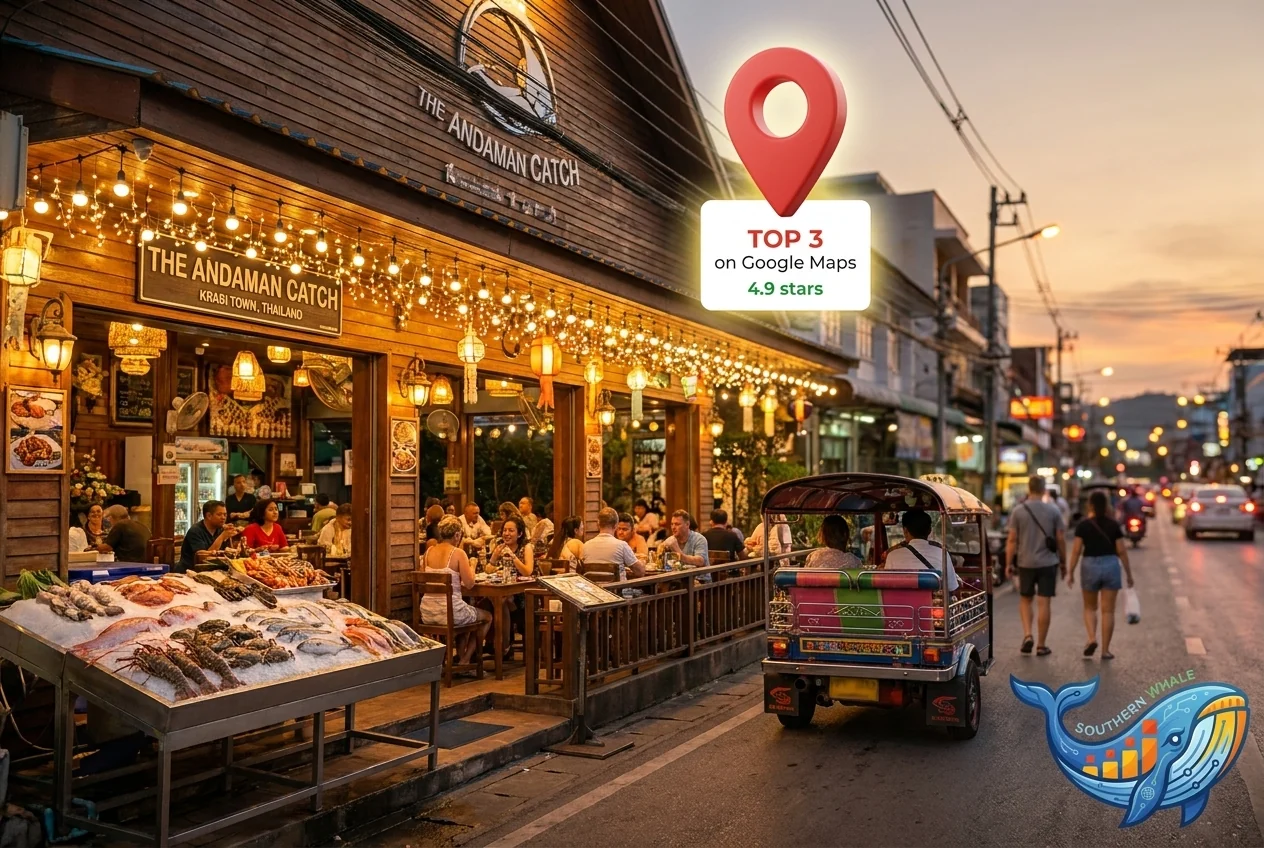
Four months post-launch the restaurant ranked #2 on Google Maps for “seafood restaurant Krabi” and #1 for “ร้านอาหารทะเลกระบี่”. Walk-ins grew from 32 to 91/day (+185%). Google Reviews grew from 47 to 312 (rating 4.7). GBP direction requests grew from 45 to 414/month (+820%). Latest month revenue: THB 4.8 million, +62% versus the baseline before our engagement started.
Lessons for F&B in tourist districts: (1) Review velocity > total review count — Google weights monthly review pace more than total count, (2) Photo quality drives click rate more than expected — restaurants with 100+ professional photos see 3.2x the click rate of those using phone photos, (3) Reply rate is a ranking signal — Google scores reply rate highly, (4) Weekly GBP posts paired with real events (festivals, special menus) push impressions +40%.
The client is now in retainer month 6 with a signed Year 2 + we’re discussing extending Maps SEO to a second branch opening in the same province, using the same playbook. See more F&B case studies or our SEO Audit services.