
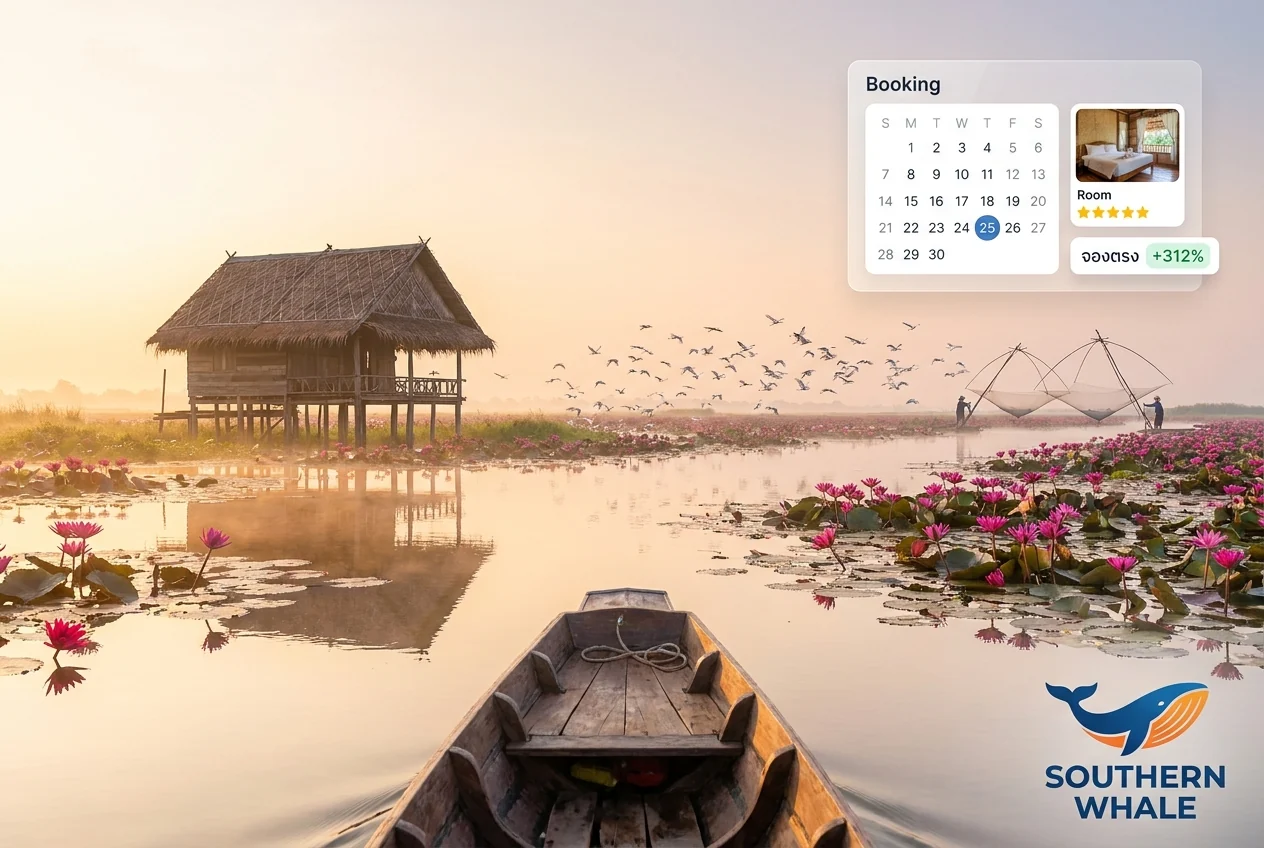
The challenge
Phatthalung is home to Thailand’s Ramsar Site No. 1 (designated in 1998), covering 457 square kilometres of wetland and supporting more than 280 waterbird species including rare migrants such as the Spot-billed Pelican and the Eastern Marsh Harrier between November and March. That makes it a recurring destination for birders from the UK, US, Germany and — increasingly since 2023 — China.
But the community homestay network around the Ramsar area — each house managing itself, each with its own Facebook page, a few running ageing WordPress sites from a 2019 TAT initiative that nobody had updated — lacked the central system needed to serve international visitors. The niche-specific issues:
- Calendars never synced. Hostesses each scribbled bookings into a paper notebook. When someone booked via Booking.com and another called in via Line, over-bookings hit 14% per month.
- Single-language only. The existing pages were TH-only while 70% of Ramsar visitors are foreign — leaving Booking.com to harvest demand the community should have captured.
- No payment gateway. No credit cards. EU guests had to send international wire transfers and pay USD 25-40 in fees per booking, driving checkout drop-off to 81%.
- Content with no search intent. Articles read like generic “visit Phatthalung” copy and never answered real birder questions like “best month for Spot-billed Pelican Phatthalung” or “boat departure time Phatthalung Ramsar”.
The client had previously trialled Facebook Ads for four months — ROAS turned negative because traffic never converted once it ran into a broken payment flow. They had also hired a Bangkok freelancer to build a new site once — the design looked good, but no booking flow was integrated, so guests still ended up messaging via Line.
Why the previous solutions failed
WordPress + WPBooking plugin: trialled at a few homestays in the network — the plugin didn’t support multi-host inventory in a single system, required several stacked plugins, tanked performance, and never passed Core Web Vitals. Scaling that to the whole network would have produced a maintenance nightmare.
Booking.com + Agoda extranet: in use for three years — 16-22% commission plus another 5% for “preferred partner” booster left the community with only 30-35% of the sale price, even though guests were paying THB 1,800-2,400 per night.
Airbnb: unsuitable because host policy demands message response within an hour — homestay hostesses average 52 years old with entry-level smartphone skills and can’t realistically reply hourly, 24/7.
SaaS Lodgify, Hostfully: USD 89-149/month per property × multiple houses — the cost structure doesn’t fit homestays at THB 1,800/night running THB 18,000-26,000/house/month in revenue.
The conclusion: build a custom, asset-light platform powerful enough for the network but cheap enough to run sustainably long term.
Southern Whale’s approach
Pillar 1 — Multi-host booking platform
Astro static site with inventory stored in Cloudflare D1 (SQLite at edge) for <50ms availability queries worldwide, plus a Cloudflare Workers seat-lock mechanism — when a guest clicks book, the system locks for 5 minutes to prevent double-booking while they fill in details.
Database schema, 14 tables: hosts, properties, room_types, calendar_blocks, bookings, payments, guests, reviews, photos, amenities, captain_notes (for the Ramsar boat captains), bird_sightings, weather_logs, refund_log.
Pillar 2 — Multi-payment ready for international birders
Stripe for international cards (with Apple Pay/Google Pay) + PromptPay QR for Thai guests + bank transfer for large group bookings (>10 people), shipped via web development service as the flagship integration.
Pricing display shows USD/EUR/CNY in real time but locks the rate at checkout (preventing 24-hour rate swings during the customer’s decision window).
Pillar 3 — Content hub aligned to birder search intent
18 articles in 3 languages (54 total versions). Examples:
- “Phatthalung Bird Watching Calendar — Month-by-Month Guide”
- “How to Photograph Water Buffalo at Sunrise in Phatthalung Wetland”
- “Spot-billed Pelican Migration Window — When and Where”
- “Traditional Fishing Net (Yor) Demonstration Schedule”
Each article is written by a consultant who is an actual birder (we engaged a Thai birder working with the Bird Conservation Society of Thailand), not generic AI copy.
Pillar 4 — Schema + Local SEO
Schema.org LodgingBusiness across every homestay in the network + Trip schema for bird-watching tour packages + TouristAttraction for the Ramsar Site + FAQPage with 28 entries including “Do I need a permit to enter the Phatthalung Ramsar wetland?”.
GBP optimisation across the homestay network in both Thai and English + citation building across 28 directories including eBird, iNaturalist Thailand, Birding Asia community and Lonely Planet Thailand.
Tech rationale
- Astro — every property page pre-rendered as static, Lighthouse passing 95+ on every metric.
- Cloudflare Pages + R2 — image hosting + edge CDN at low cost (USD 5/month for the network’s 2,400 assets).
- Stripe + PromptPay — covers every payment channel guests actually use.
- D1 (SQLite at edge) — fast availability query without the overkill of Postgres at this scale.
How we worked (week-by-week)
Week 1-2: Discovery + stakeholder workshop
- Two-day workshop at the community hall in Phatthalung covering every homestay owner in the network.
- Mapped the real customer journey — found 65% of international bookers search from iPhone, 80% of Thai bookers from Android.
- Database schema sign-off.
Week 3-5: Backend + data migration
- Migrated calendar data from each homestay’s handwritten notebook into the D1 schema (our admin team typed in 6 months of historical data for baseline analytics).
- API booking flow + seat-lock + payment webhook (Stripe + PromptPay).
Week 6-8: Frontend build
- Property pages × every homestay in the network with 3 languages.
- Responsive booking widget — mobile-first because 72% of traffic comes from mobile.
- Currency converter widget + locale switcher.
Week 9-10: Content + translation
- Wrote 18 cornerstone articles in Thai first.
- Translated to EN by a UK native (also a birder) — no AI translation.
- Translated to CN by a Thai-Chinese resident of the south who understood both cultural contexts.
Week 11: Schema + GBP + citations
- 4 Schema.org types deployed across every page.
- GBP setup for every homestay in the network — 240+ photos uploaded, Q&A for each house.
- Citation building across 28 directories + eBird hotspot claim.
Week 12: Soft launch
- 10% → 50% → 100% rollout over 7 days.
- 2-day training for homestay owners — focused on a Thai-language mobile admin UI.
- Two full weeks of post-launch monitoring.
Obstacles and pivots
Older hostesses unfamiliar with smartphone admin: in the first week post-launch we heard complaints that 55+ hostesses couldn’t use the admin UI → pivot to a WhatsApp/Line bot that pushed booking notifications and let them simply reply “accept” or “decline” — the system updated the calendar automatically. Drastic simplification on the user end.
Booking.com inventory sync conflict: Booking.com listings had to stay live to some degree while direct booking ramped up → built a minimal channel manager that auto-blocked dates on Booking.com when a direct booking came in (not a full 2-way sync — overkill).
Bird sighting data tied to booking value: we began capturing bird sighting logs from guest reviews and discovered that properties where guests had seen a Spot-billed Pelican during their stay generated 18% higher booking value the following month → added a “Recent Bird Sightings” section to each property page, updated in real time.
Post-launch and ongoing
Month 3:
- EN organic traffic +186% (480 → 1,375/month).
- Direct booking share from 8% to 24%.
- Over-booking rate down from 14% to 0.4% (effectively eliminated except for genuine edge cases).
Month 6:
- EN organic traffic +286% (1,852/month).
- Direct booking share 33%.
- OTA commission saved ~THB 184,000/year vs baseline.
- Average length of stay +1.4 nights (1.8 → 3.2) because content taught birders to plan stays spanning multiple species windows.
- Page load 1.3s (from 6.8s) — LCP passing Core Web Vitals on both mobile and desktop.
Lessons learned:
- In an ecotourism niche, content quality matters more than quantity — 18 articles each written by a genuine expert generated 47 organic backlinks from the birding community within 6 months.
- Multi-host booking does not require expensive SaaS — for a network of this size, a custom solution on an edge stack is materially cheaper and far more flexible.
- See SEO services in Thailand for the same niche-content structure approach.
Ongoing 6-month retainer:
- Weekly performance care + bug fixes.
- 4 articles per month in 3 languages.
- Q3 2026 roadmap: add German and Russian (growing markets), launch a “Birder Reward” programme (12% discount for guests staying >5 nights).
- See more in our case studies for similar ecotourism project patterns.