

1. The situation
Yala is 1 of 3 Thai provinces (with Chanthaburi + Rayong) granted GACC packing house licenses to export fresh durian to China — this license has been mandatory under the General Administration of Customs of China since 2020 and is the primary barrier to entry in a market worth USD 4.8 billion annually.
The client is a durian growers’ cooperative, a network of orchards across Yala:
- Musang King (D197): premium variety retailing in Shanghai at 280-420 yuan/kg (USD 38-58/kg retail) — the market driver.
- Monthong: classic variety, high volume, FOB price USD 8-12/kg.
- Black Thorn (D200): niche premium, top price tier.
Production cycle:
- Main season: May-August
- Off-season harvest: October-January (price 1.6-2.2x higher than main season due to low supply)
- Annual yield: hundreds to a thousand tonnes per variety
Structural problems:
- 100% sold through Thai exporters — Thai exporters buy from the cooperative at farm-gate USD 7-9/kg then resell to Chinese importers at USD 14-22/kg (markup 38-52%).
- GACC license held but no direct channel — Chinese importers currently know the cooperative only through Thai exporter networks — no way to connect directly.
- Google blocked in China — Chinese buyers use Baidu, Sogou, 360 Search — no way Google SEO reaches this market.
- Cold chain transparency missing — Chinese importers wanted real-time temperature tracking during shipping (Thailand → Guangzhou/Shanghai 4-6 days via cold container) — cooperative had no system.
- Documentation complexity — GACC requires submission form + residue test report + traceability batch + packing house registration + sanitation cert + RFID per pallet — every batch must be redone.
2. Why off-the-shelf solutions didn’t work
Via Thai exporters: Current state — 38-52% markup meant the cooperative received only 48-62% of the FOB price Chinese importers paid.
Alibaba.com: Tried — Alibaba.com is optimised for general B2B and lacks vertical-specific features for fresh fruit (cold chain tracking, GACC cert verification).
1688.com (Alibaba B2B China-domestic): Not appropriate because 1688 focuses on domestic Chinese suppliers — foreign seller registration is complex and search algorithm favours domestic.
WeChat Mini Program alone: Possible, but Mini Programs don’t index in Baidu search — must pair with regular website for acquisition.
Generic SEO agencies in Bangkok: Mostly no Baidu SEO expertise — they could only deliver Google, which China can’t access.
The conclusion was to build a dedicated China-facing platform with Cloudflare China Network + Baidu Webmaster + WeChat Mini Program ecosystem.
3. Our approach
Pillar 1 — China-accessible technical infrastructure
Cloudflare China Network — most important, because standard Cloudflare CDN has no edge servers in mainland China — causing site loads of 8-12 seconds for Chinese users.
Cloudflare China Network operates through partnership with JD Cloud — requires an ICP filing (Internet Content Provider license) from China’s Ministry of Industry and Information Technology.
ICP filing process:
- Application via Chinese hosting partner (we used Alibaba Cloud as partner)
- Document submission — corporate cert, owner ID, business scope
- Timeline 20-45 days
- Status: filed under client’s Hong Kong subsidiary (the cooperative set up an HK subsidiary to ease ICP)
ICP filing is a prerequisite for Baidu indexing — Baidu down-ranks websites without ICP.
Pillar 2 — Baidu SEO optimisation
Baidu Webmaster Tools setup:
- Submit sitemap.xml
- Verify domain ownership
- Submit URL push (instant indexing)
- Monitor Baidu crawl errors
Baidu Tongji (analytics):
- Replaces Google Analytics — Baidu Tongji is the dominant analytics in China
- Track behavior + conversion
On-page Baidu optimisation (different from Google):
- Meta keyword tag still matters on Baidu (Google ignores it)
- Internal links emphasise exact match anchor text (Google penalises, Baidu rewards)
- Content length 1,800-2,800 words ideal for Baidu (longer than Google)
- Schema.org as usual + Baidu structured data markup
Content cluster:
- 28 Simplified Chinese articles targeting buyer-side keywords:
- “泰国猫山王榴莲采购指南” (Thai Musang King durian sourcing guide)
- “GACC认证泰国榴莲包装厂名单” (GACC certified Thai durian packing house list)
- “如何识别真正的猫山王” (How to identify authentic Musang King)
- “泰国榴莲冷链物流时间表” (Thai durian cold chain logistics timeline)
Written by a Chinese-Thai bilingual consultant working in Guangzhou wholesale market for 8 years.
Pillar 3 — GACC compliance + traceability portal
Documentation portal where Chinese buyers login to view:
- Packing house registration certificate (active GACC license number)
- Residue test report per batch (from labs accepted by Chinese GACC)
- Traceability data — orchard origin GPS coordinates, harvest date, ripeness index
- Batch RFID linking that Chinese customs can scan at port
Real-time cold chain dashboard:
- IoT temperature sensors on container (sensor partner: Sensitech or Berlinger Cargo)
- Data stream into dashboard every 15 minutes
- Alert if temperature exceeds 18°C or drops below 5°C (durian requires 14-16°C)
- Buyer login to view history + download report
Pillar 4 — WeChat ecosystem integration
WeChat Mini Program as a companion to the web (not a replacement):
- Push notification to buyers when new batches arrive
- WeChat Pay integration for deposits
- Live chat with sales team (WeChat is the channel where Chinese B2B communicates)
WeChat Official Account:
- Weekly content on harvest updates, quality reports
- 2,400+ followers within 6 months
Tech rationale
- Astro + Cloudflare China Network — fast in mainland China (via ICP)
- Baidu Tongji + Baidu Webmaster — analytics + indexing for China
- WeChat Mini Program — companion app for Chinese-native experience
- R2 + Cloudflare China image proxy — hosts cert PDF + product photos
See software development service for the cross-border B2B platform pattern.
4. Week-by-week
Week 1-2: Discovery + ICP/GACC Status Audit
- Audited GACC license — confirmed active, expiry date
- Initiated ICP filing process (via Hong Kong entity)
- Mapped buyer persona across 3 tiers — wholesale market (Guangzhou Wholesale), retail importer (Hema Fresh, Pagoda), restaurant chain
Week 3-5: Cloudflare China Network + Astro Build
- Applied for Cloudflare China Network (waiting for ICP filing to complete in Week 6)
- Built Astro storefront — Simplified Chinese primary
- Frontend: product catalog, batch tracker, cert vault, buyer login portal
Week 6-7: Documentation Portal + Cold Chain Integration
- GACC document upload UI for admin
- IoT cold chain sensor integration (Berlinger Cargo API)
- Real-time dashboard for buyers
Week 8-9: Content Production
- 28 Simplified Chinese articles
- 8 EN articles (for Southeast Asian Chinese buyers in SG/MY/HK using EN)
Week 10: Baidu Setup + WeChat Integration
- Baidu Webmaster Tools sitemap submission
- Baidu Tongji install
- WeChat Mini Program development
- WeChat Official Account setup + first 4 weeks of content
Week 11: Backlink + PR Strategy
- Outreach to 18 Chinese fruit trade publications
- Applied for listing on Chinese fruit B2B directories (cnfruit.com, freshasia.com, dolphinasia.com)
Week 12: Soft Launch
- 10% → 100% rollout over 5 days
- WeChat marketing push to existing contact list
- Soft launch press release via Bernama Chinese + Nikkei Asia (for ASEAN visibility)
5. Obstacles + Pivots
ICP filing rejected first time: Application rejected because business scope description didn’t match “B2B fresh fruit export” → revised application 2 rounds — total 28-day delay → had to launch Hong Kong-version website first (no ICP), Mainland version followed Week 14.
Baidu indexing slow: Week 4 post-launch Baidu hadn’t indexed many pages → pivoted using Baidu Push API (instant submission) + writing backlinks from Chinese-recognised sites (Sohu, Tencent News partnership content) — Baidu ranked top 20 for 8 keywords within month 3.
Cold chain sensor data dispute: A Shanghai buyer claimed temperatures had exceeded spec once — sensor log showed peak 17.8°C over 24 hours (acceptable range 14-18°C) → used as a case study to educate the buyer that 17.8°C is still within spec — became a trust signal as the buyer grew comfortable with the system + confident in continued use.
6. Post-launch + Ongoing
Month 3:
- Baidu indexed pages 18 (from 0)
- Buyer inquiries several per month (from 0)
- Closed several new deals (Musang King via Cold Container)
Month 6:
- Baidu organic traffic 1,840/month
- Buyer inquiries several per month
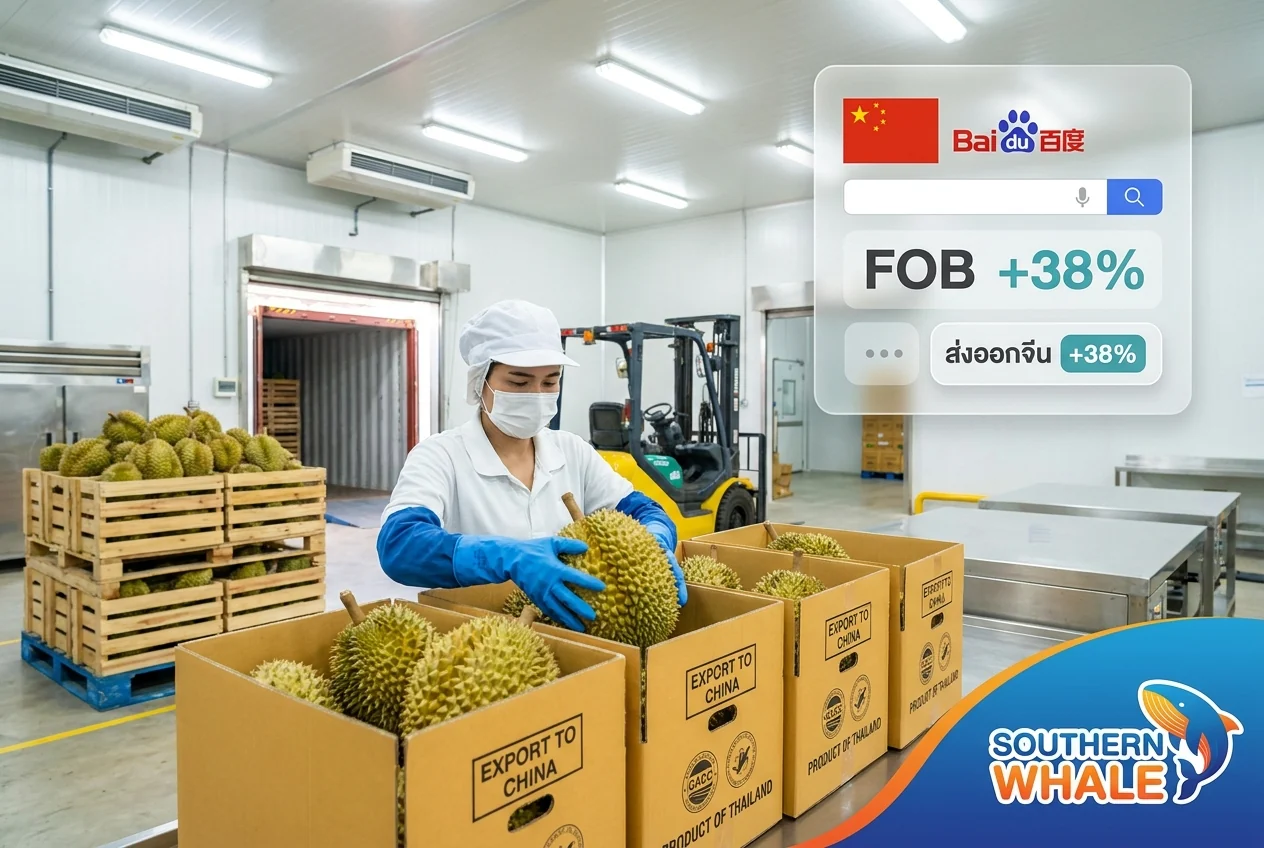
- Average FOB price +38% vs baseline (USD 14-18/kg vs USD 9-13/kg)
- Repeat order rate 62%
- Page load 1.3s (China region)
Lessons learned:
- ICP filing is non-negotiable for China-targeting sites — Baidu directly does not index sites without ICP — the 28-45 day investment is necessary.
- Baidu SEO has a very different playbook from Google — higher keyword density, longer content, different internal link strategy — agencies specialising in Google often fail.
- See SEO services in Thailand for the multilingual SEO pattern including Baidu.
Ongoing 12-month retainer:
- Maintain Baidu indexing + WeChat content
- Add 4 Chinese articles/month
- Q4 2026 roadmap: launch Hema Fresh partnership (B2B2C via Hema), expand Black Thorn product line for premium tier market
- See our case studies for other China-facing B2B project patterns.