

Who this case is for
If you run a wholesale, procurement or B2B supply business and you’re thinking “a one-page site to introduce the company is enough”, this case is for you.
We cover the day the client asked for a one-page site, why we suggested a different plan, the search data that convinced them, the system we built, and the day Google’s AI Overview described the client’s business correctly, the day after the site went live on its real domain.
We don’t name the business, to protect the client’s privacy.
Highlight: one day live, and Google’s AI already gets the business
The site went live on its real domain on the evening of 2 October 2026. The next day we searched the brand name on Google, and an AI Overview box appeared at the very top.
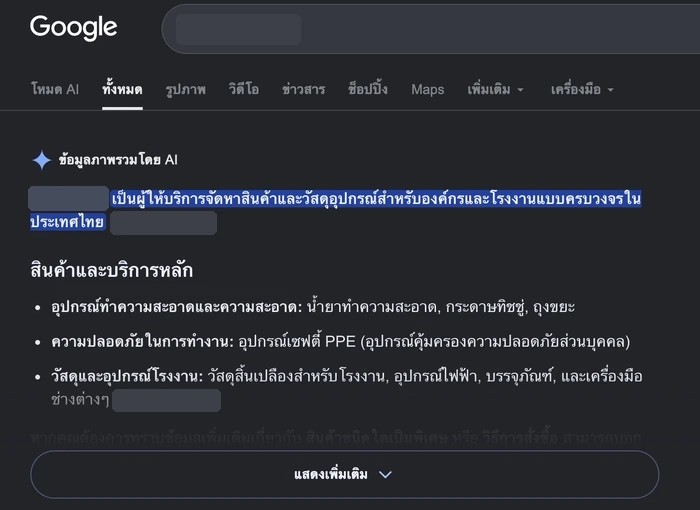
Google’s AI did three things we designed the site for:
- It said correctly what the company does: an end-to-end provider of goods and supplies for organisations and factories in Thailand. It read the business as B2B, not as a retail shop.
- It grouped the main products and services: cleaning supplies, workplace safety (PPE), and factory materials and equipment. These come straight from the category structure we planned.
- It cited the client’s own site as the source. The first organic result under the AI box is the client’s homepage.
To be clear: this screenshot comes from a brand-name search, not a generic product search. But this company had never had a website or a Facebook page, and the domain was registered the same day. Google understanding the business correctly from day one shows the structured data, category pages and Schema are doing their job. Anyone who hears the company name and looks it up now gets an accurate answer straight away. Rankings for product searches take time while Google collects data. We’ll update this case once Search Console has numbers.
1. The client asked for a one-page site
The client is a procurement company in Greater Bangkok. Its customers are factories, warehouses, hospitals, office buildings and contractors. The business has three parts:
- Sourcing goods and consumables, such as garbage bags, cleaning chemicals, tissue paper, PPE, packaging and industrial chemicals
- OEM and private label manufacturing
- Outsourcing of packing and service work
The client arrived with website mockups generated by AI and wanted the site to look like that. The brief was a one-page site in Thai and English, no catalogue, focused on contact. But the goal the client wrote down was “show up in search, make contact easy, increase sales”.
A free draft before any commitment
We built a working one-page bilingual demo from the client’s mockups and put it online the same day we first talked, before the client had paid anything. If they didn’t like it, they could walk away at no cost.
The reason is simple: AI mockups look great on screen, but turning them into a real site raises lots of decisions. Thai text runs longer than English, and buttons need a place on mobile. Showing the client something real, fast, makes the conversation far easier than sending designs back and forth.
Why we took a THB 5,000 project
Honestly, that’s a budget website. We took it because procurement suppliers for factories are a business we rarely see commissioning websites. The product range is huge, from garbage bags to industrial chemicals, nothing has a price on the site, and the buyers are bilingual purchasing teams. It was a challenge, and we wanted to see how well we could get Google to understand a business like this.
Those two things pull against each other, so we explained this before starting:
People who don’t know your company will never search for its name. They search for the product they need. A one-page site only gets found when someone types the company name, which means relying on ads alone.
Then we offered to do a keyword analysis for free first, and let the numbers make the call.
2. The search data: purchasing teams search by product name
We pulled Thai-market data from Ahrefs on 19 September 2026: over 150 keywords covering every product category and service, and we opened the live search results for the key terms.
The finding that changed the plan: “procurement-style” phrasing has almost no searches, while product names get thousands to tens of thousands.
| Product name (Thai search) | Searches / month | Procurement phrasing | Searches / month |
|---|---|---|---|
| safety shoes | 15,000 | safety shoes, wholesale price | 30 |
| PPE kit | 12,000 | factory safety equipment | 20 |
| tissue paper | 14,000 | tissue paper, wholesale | 0 |
| floor cleaner | 5,200 | cleaning products, wholesale price | 20 |
| black bags | 1,700 | black bags, wholesale price | 0 |
| pallet stretch film | 1,300 | factory consumables | 10 |
| consumables | 500 | sourcing company | 0 |
Thai-market keyword data from Ahrefs, 19 September 2026 · estimates · keywords translated from Thai
Search results and competitor data from Ahrefs, 19 September 2026
What the numbers say:
- Small sites can win if they have a page that matches the search. Several top-ranking sites had a very low Domain Rating but a category or product page that matched the keyword.
- AI Overviews sit on almost every results page, and the AI tends to cite specialist sites with clear structure. A one-page site has almost no chance of being cited.
- Watch for keywords that mean something else. In Thai Google, “mro” returns aircraft maintenance, and the Thai term for “packing service” returns e-commerce fulfilment, not in-factory work.
- “OEM” is still open for workplace consumables. The results only show food and cosmetics manufacturers.
- Measure quote requests, not visits. One B2B customer is worth more than hundreds of visitors.
We sent the client a report with two options: a one-page site that relies on ads, or a site with category and service pages. The client chose the second option the same day.
3. What we built
A 28-page site built around what purchasing teams search for
| Section | Pages (per language) | Details |
|---|---|---|
| Homepage | 1 | Keeps the one-page layout the client liked, so the whole company can be scanned on one page |
| Product categories | 10 | Garbage bags · cleaning · tissue · PPE · factory consumables · electrical & lighting · office supplies · packaging · tools · chemicals |
| Services | 3 | Procurement & sourcing · OEM & private label · Outsourcing |
That’s 14 pages per language × Thai and English = 28 pages.
- Short English URLs in both languages, with all 13 old URLs 301-redirected
- A mega menu showing 10 categories with thumbnails and example products, plus the 3 services on the right; keyboard accessible, and a collapsible accordion on mobile
- FAQ on every category and service page, answering what purchasing teams actually ask, with FAQ Schema generated automatically from the on-page blocks
- Full Schema: Organization, WebSite, BreadcrumbList, FAQPage, CollectionPage, Service and OfferCatalog, plus Thai/English hreflang and canonicals
- No size-by-size product pages, in line with the client’s policy of adjusting specs per project: one category page with a product list and FAQ instead
- No fixed numbers for specs, minimum orders or lead times, as the client asked. The site says terms are flexible, based on each customer’s needs and project scope
New AI imagery for the whole site, because the client had no photos
The client had a logo and the AI mockups, but no product, warehouse or team photos. So they asked us to create all the site imagery with AI. We generated more than 35 images:
- 13 page cover images
- 10 product category images, 7 customer-industry images (factories, warehouses, hospitals, buildings and more) and 3 service images
- The homepage building image, recreated sharper and more realistic from the client’s own mockup
- A sharper logo rebuilt from the client’s small file
Every image shows unbranded products, as the client asked, because brand and spec depend on each customer’s needs. We also advised swapping in real photos over time, since real photos help both trust and image search.
A quote-request (RFQ) system we designed and built from scratch
B2B buyers don’t use a cart and don’t see prices. What the sales team needs is a request complete enough to quote straight away. We designed the flow for the client ourselves, with no off-the-shelf plugin:
- Pick from 88 products in 10 categories (imported from the client’s Excel file), with quantity and spec per line, type-ahead search, and free-text “items not on the list”
- An automatic reference number for every request
- A PDF request generated on submit, with company letterhead, the product table and attachments listed, and Thai vowels and tone marks rendered correctly
- File attachments (PDF, images, Word, Excel, PowerPoint), with real file-type checks and a total size cap so emails stay within mailbox limits
- Spam protection with a bot trap and a minimum fill time
- An admin area that stores every request, is searchable, shows email delivery status, downloads the PDF and attachments (attachments can’t be opened from outside), and exports to Excel (CSV) with one row per product line
- 12 quote buttons across the site, all leading to the same form
Emails were silently disappearing, and we fixed it before launch
While testing on the temporary server, we found form emails vanishing without a trace. The system reported them as sent, but they never reached the inbox, not even spam. The temporary domain had no sender-verification records (SPF/DKIM), so mail providers simply discarded them.
We switched to sending over SMTP through a dedicated company mailbox. Requests with their PDF now land in the main inbox, not spam, both for the team and for the requester’s copy.
If your site has a contact form, send test messages to several email providers. A form that says “sent” on screen doesn’t always mean the email arrived.
WordPress the client can edit block by block
The prototype was built in Astro for speed, then moved to a custom WordPress block theme we wrote, so the client’s team can edit text, images, products and FAQs themselves without breaking the design.
- Every page is built from standard WordPress blocks, and all 1,684 blocks pass WordPress’s own validation
- The WordPress homepage matches the prototype on 342 of 342 elements, on both desktop and mobile
- A built-in bilingual system with no translation plugin: Thai and English pages are paired from a box in the editor sidebar
- Security hardening: login lockout after repeated wrong passwords, the admin file editor disabled, security headers added
- A 17-page manual readable right inside the admin, only for logged-in users. When it’s updated, the client sees the new version straight away
Measuring from day one
- Google Analytics 4 counts every successful quote request as a
generate_leadevent, with language and reference number - Google Search Console domain verified and a sitemap of all 28 pages submitted on launch day
- Checked that every page returns 200 with exactly one main heading (H1), internal links need no redirects, and every image has alt text
Three major revision rounds before handover
This wasn’t a one-shot job. The client sent feedback in batches, and we made three major revision rounds:
| Round | What changed |
|---|---|
| 1 | From a one-page site to 28 pages, English URLs, a mega menu, and every fixed spec, minimum order and lead time removed in line with client policy |
| 2 | A 14-point feedback sheet plus the 7-step quote flow the client wanted, more chemical products, and the whole site moved to WordPress so the client can edit it |
| 3 | Menu tweaks, menu highlighting for the section in view, and mega-menu behaviour before going live on the real domain |
After every round we rechecked that every page loads, main headings are unique, and the quote-request system still works end to end.
Extras at handover
- A 17-page website manual, readable inside the admin
- A 22-page Google Ads setup guide. The client runs ads themselves, so we wrote a guide with real screenshots of every step, from creating the account and connecting measurement to the quote form, to example keywords and ad copy for each category
4. A 15-day timeline
| Date (2026) | What happened |
|---|---|
| 17 Sep | The client sent AI mockups and asked for a one-page bilingual site · we put a free draft demo online the same day |
| 19 Sep | B2B keyword analysis → the client chose the multi-page plan → the 28-page site was on the demo the same day (revision round 1) |
| 21 Sep | Products imported from the client’s Excel file |
| 24–25 Sep | 14-point feedback (revision round 2) · new AI imagery for the whole site · quote-request system built · moved to a WordPress block theme |
| 1 Oct | SMTP email working, requests land in the main inbox |
| 2 Oct | Revision round 3 · Live on the real domain with HTTPS · Search Console · GA4 |
| 3 Oct | Google’s AI Overview describes the business correctly · website manual and Google Ads guide delivered |
5. What we expect next
What we can measure today is that Google understood the business correctly from day one. What follows are targets we’ll track, not results yet:
- Category pages starting to rank for zero-difficulty product keywords. In a market where small sites can still win, movement usually starts in months 2–4
- Category pages being cited in AI Overviews for product searches, not just for the brand name
- Quote requests from the site, measured by the
generate_leadevent in GA4, by page and language
We’ll update this case once Search Console has data.
Checklist for suppliers and B2B businesses
Site structure
- Each main product category has its own page, not bundled on one page
- Page titles use the product names customers actually search for, not internal jargon
- There’s an FAQ answering purchasing questions, such as minimum orders, tax invoices and delivery areas
- There are English pages, if you serve foreign-owned factories
Sales
- A quote button sits on every category and service page
- The form collects enough to quote straight away (product, quantity, spec, attachments)
- You’ve sent a test form and the email really reached the main inbox
- You can count requests coming from the site (for example in GA4)
AI search
- Search your company name on Google and check whether the AI describes your business correctly
- Your site has Schema saying what the company does, what it sells and where it serves
Questions B2B owners often ask us
Is a one-page site really not enough? It’s enough for people who already know your company, but not for people who don’t, because they search by product name. Without a page that matches that product name, the only way to be seen is to pay for ads.
Do we need a page for every product? Not necessarily. For businesses that adjust specs per project, start with category pages that list example products and answer FAQs. Add dedicated pages later for best sellers or heavily searched products.
Why do AI Overviews matter for B2B? In our check, 10 of 11 results pages in this market had an AI box on top. Many purchasing staff read that answer before clicking any site. If the AI gets your business wrong, or doesn’t know it at all, you lose the chance before the buyer ever sees your site.
Can a budget website really be good? It depends on what was cut to make it cheap. This project had a THB 5,000 budget but kept everything that helps a site win customers: keyword research, category pages, Schema and a quote-request system. Ask anyone offering a cheap website: will there be pages matching what customers search for, can we edit it ourselves, and can we measure who contacts us through it?
Can we build a website with no product photos? Yes. This site uses AI-generated imagery throughout, showing unbranded products that fit the business, with real photos swapped in over time.
Can our team edit the site ourselves? Yes. In this case the client’s team edits text, images, products, FAQs, contact details and quote-request recipients themselves. Structural work, like design changes or new features, is still a developer’s job.
We’ve built websites and SEO for B2B businesses like this
If you’re a supplier, distributor or manufacturer looking for a website that fits a modest budget but still wins customers, on Google and in AI Overviews, start with a free website audit, or see our web development services and SEO services.