

Who this case is for
If you pay for SEO, get a report every month, see a great score every month, and still don’t see more enquiries, this case is for you.
We cover the day a B2B rubber factory asked us to check its website, what the previous reports couldn’t see, how we found it, and what happened next. After the client fixed the issues our report identified, daily clicks were back above the previous peak within 6 days.
Every number in this case comes from the client’s Google Search Console. Market data comes from Ahrefs. We don’t name the client or show real URLs.
1. The brief: two SEO providers already
The client manufactures industrial and construction rubber, sold B2B. Its buyers are contractors and factories who send drawings and ask for quotes.
| Website facts | Details |
|---|---|
| Platform | WordPress + Elementor + WooCommerce |
| Pages | 6 pages · 12 posts · 43 products · 13 product categories (74 URLs in total) |
| Domain age | About 1.5 years (most competitors are 12–18 years old) |
| Competition | Low: many first-page sites have a Domain Rating of 0–15 |
The market wasn’t crowded, but the client had already changed SEO providers twice. The current provider’s monthly report showed a Health Score of 100, yet the client felt it wasn’t working.
What the client wanted was clear: a team that diagnoses the real problem and measures success by quote requests, not by how many articles get published.
So we offered a full diagnostic audit first, free of charge.
2. Why the previous report couldn’t see the problem
The August report from the previous provider relied mainly on third-party tools. Compared with real data on the day we checked, several key numbers told a different story.
| Topic | Previous report | What we actually found |
|---|---|---|
| Site health | Health Score 100, “Excellent” | The pages earning the most clicks redirected to the homepage, the sitemap was broken, and every non-existent URL redirected to the homepage |
| Duplicates | “Indexable but duplicate: 122 of 146”, marked as no impact | 29 product pages with duplicate content, competing against each other |
| Ranking keywords | 4 (third-party tool) | Search Console showed 280 queries with impressions, 43 on page one, and 64 more in positions 11–20 |
| Traffic | Third-party estimate ~22 clicks/month | Search Console actual ~177 clicks/month (about 8x higher) |
| Business measurement | No enquiry data | The client wanted to track quote requests and drawing submissions |
We simply lay the data side by side. The point is why an overall score can be misleading.
Most site-audit tools build their Health Score from technical errors only. A page that redirects to the homepage isn’t counted as an error, because the redirect works as intended.
For the business, though, that’s a sales page that has vanished from Google.
An audit tool asks “does this link work?” and the answer is yes. The right question is “does the customer who clicks this link see the product they were looking for?” The answer was no.
3. How Southern Whale audits
We don’t trust the overall score, and we don’t start from third-party tools. We start from what Google actually sees, and go page by page.
| Step | What we did |
|---|---|
| 1. List every page | The sitemap didn’t work, so we pulled all URLs from the WordPress REST API: 74 in total |
| 2. Check each URL | HTTP status, redirects, canonical, title, meta, H1, and internal links in and out, for every page |
| 3. Click every menu link | We clicked each product link in the menu to see where it really went |
| 4. Search Console by page | Which group of pages earned the clicks, and whether those pages still opened |
| 5. Search Console by day | When the damage started, and the last date Google read the sitemap |
| 6. Use the site for real | Desktop and mobile, Lighthouse, and browser console errors |
| 7. Compare with the market | SERPs and competitors, to separate market problems from site problems |
Steps 3 and 4 are what made the difference here. Clicking through your own menu takes under a minute, and it showed us the biggest problem immediately.
4. What we found
4.1 The main bottleneck: sales pages sent back to the homepage
| Finding | Scale | Impact |
|---|---|---|
| Product category pages in the menu 301-redirected to the homepage | 11 of 12 categories | Visitors clicked the menu and landed on the homepage; Google gradually dropped the rankings |
| /product-category/ URLs bounced through 2 redirects to the homepage | Every category | All links from blog posts used this URL format |
| Old-format product URLs redirected to a double-encoded Thai URL, then on to the homepage | 13 pages | 11% of clicks still went to this group |
| Every sitemap file 301-redirected to the homepage | Whole site | Google last read the sitemap on 16 Sep 2026 |
| Non-existent URLs 301-redirected to the homepage (soft 404) | Whole site | Google couldn’t tell real pages from missing ones |
| http:// didn’t redirect to https, and canonicals pointed to http | Whole site | Google stored a second, duplicate set of pages |
4.2 The evidence from Search Console
We didn’t conclude anything from gut feeling. Search Console shows exactly which pages earned the clicks, and what state those pages were in on the day we checked.
| URL group | Share of clicks | Share of impressions | Status on audit day |
|---|---|---|---|
| Category pages + old category URL format | 44% | 56% | 301 to homepage |
| Old-format product URLs | 11% | 6% | 301 to homepage |
| Homepage | 24% | 9% | Normal |
| Blog posts + working product pages | 20% | 28% | Normal |
Google Search Console data, 24 Jun – 23 Sep 2026 · shares calculated from page-level totals
In total, 55% of clicks and 62% of Google impressions came from URLs that were redirecting to the homepage at the time. The site’s best-selling pages were the ones with the door shut.
4.3 Secondary issues holding the sales pages back
| Finding | Scale |
|---|---|
| Product pages with no internal links pointing to them | 41 of 43 |
| Blog posts with no internal links pointing to them | 8 of 12 |
| Links from blog posts to product pages | 0 (some posts linked only to the homepage) |
| Internal links across the site | 1,852 · 48% of in-content links pointed to image files |
| Product pages with duplicate content | 29 |
| Empty meta descriptions | 23 pages |
| Mobile speed (Lighthouse) | Score 38, largest image (LCP) loading in 18.3 seconds |
| Fonts failing to load on every page | 4–5 fonts (CORS between the www and non-www domains) |
These matter, but they’re not what to fix first. If the sales pages don’t open, no amount of good internal linking can get visitors there. So our plan put the main bottleneck first.
5. Timeline
| Date | Event |
|---|---|
| 16–31 Aug 2026 | Previous peak: 7.5 clicks / 249 impressions per day |
| Aug 2026 | The previous provider’s monthly report shows Health Score 100 |
| 1–15 Sep 2026 | Decline begins: 6.1 clicks / 200 impressions per day |
| 16 Sep 2026 | Google reads the sitemap successfully for the last time |
| 26 Sep 2026 | Southern Whale delivers the audit report and 4-month plan, free of charge |
| Around 27 Sep 2026 | Category pages open again and the sitemap works, following the issues in the report |
| 27 Sep – 2 Oct 2026 | 7.8 clicks / 277 impressions per day, above the previous peak |
Notice that clicks started falling in early September while the previous month’s report still showed 100. The last date Google read the sitemap is a warning sign you can see before clicks drop hard, if someone is watching.
6. Obstacles during the audit
Sites with structural problems often can’t be audited with standard tools. This one was no exception.
| Obstacle | How we handled it |
|---|---|
| The sitemap didn’t work, so a standard crawler found 0 pages | We pulled the URL list from the WordPress REST API instead: all 74 URLs |
| The site blocked non-browser user agents (403) | We audited with a real browser user agent |
| Third-party numbers were about 8x lower than reality | Search Console became the main source; third-party tools were used only for market and competitor views |
The first point explains why the audit tool scored the site so highly. A crawler that finds no pages also finds no errors.
7. Results after the fix
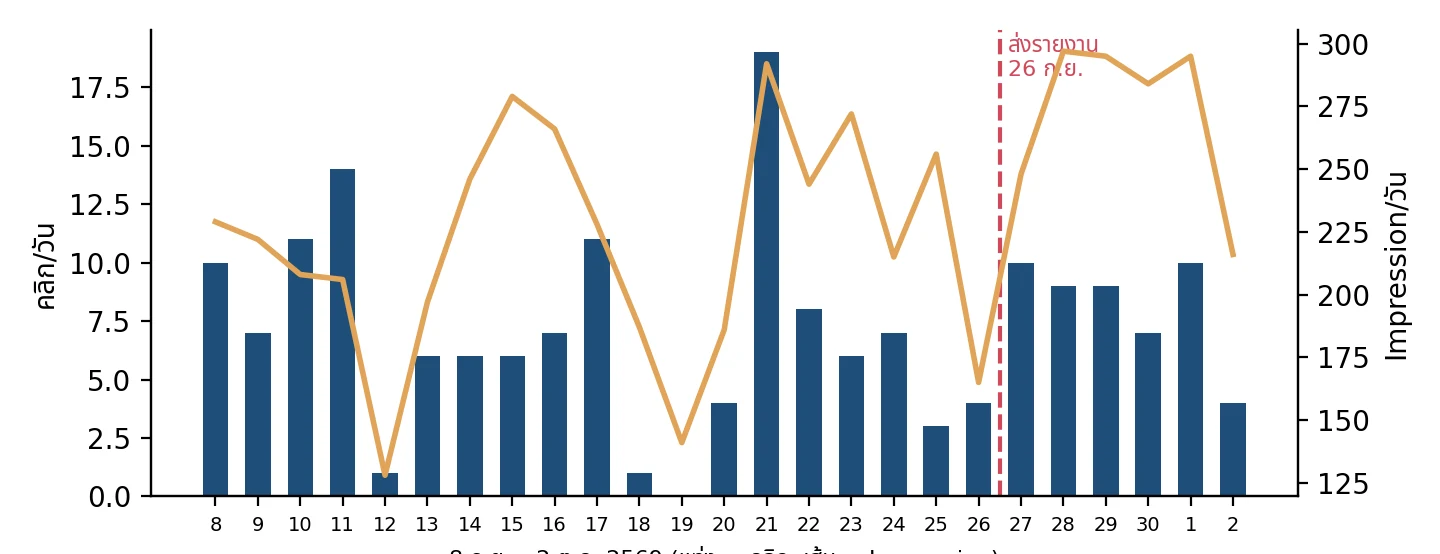
The client received our report on 26 Sep 2026 and fixed the issues it identified. Within 6 days of the fix, daily clicks were back above the previous peak.
previous peak
decline
audit period
after the fix
| Period | Clicks/day | Impressions/day | Average position |
|---|---|---|---|
| 16–31 Aug (previous peak) | 7.5 | 249 | 6.8 |
| 1–15 Sep (decline) | 6.1 | 200 | 7.7 |
| 13–26 Sep (audit period) | 6.3 | 229 | 6.7 |
| 27 Sep – 2 Oct (after the fix) | 7.8 (+24%) | 277 (+21%) | 6.1 |
Percentages compared with the audit period (13–26 Sep 2026)
Pages that recovered most
| Page | Before | After |
|---|---|---|
| Main product category (construction products) | ~0.5 clicks/day | ~3 clicks/day, position 5.8, now the site’s top click-earning page |
| Secondary category page | Redirected | Back at an average position of 3.9 |
| Old category URL format (/product-category/) | In the list of click-earning pages | Gone from the list as Google consolidates signals on the main URL |
What this proves: the lost rankings weren’t lost because competitors got stronger. They were lost because the pages were shut off. Once access was restored, Google gave the rankings back within days. A diagnosis that points at the right spot delivers faster than months of routine SEO work.
8. Southern Whale’s view: fasten the first button right, and it isn’t slow
The 4-month plan we proposed started with the site’s structure, then moved on to sales pages, content and growth. For a client let down by several providers, a plan that doesn’t start with articles or instant ranking gains can look slow.
This case answers that clearly: going back to fasten the first button properly is not slow at all. Fixing a handful of root causes got clicks recovering the very next day, and above the previous peak within 6 days. That’s faster than months of articles or link building on top of a broken structure.
The rule we apply to every site: if the first button is wrong, every button after it is wrong too. An article that links to a page that won’t open doesn’t sell, and a backlink pointing to a redirected page doesn’t help rankings. So we always fix the root first, because it’s the fastest work with the biggest payoff.
We produced this report without charging a single baht, because showing the real problem with evidence proves our skill better than any promise.
9. Five lessons from this case
| # | Lesson | In practice |
|---|---|---|
| 1 | An overall score isn’t the site’s real health | A Health Score of 100 can coexist with shut-off sales pages; look at page-level data |
| 2 | Use Search Console as your main source | Third-party tools underestimated clicks by about 8x and couldn’t show which pages earned them |
| 3 | Click every link in your own menu | The biggest problem in this case could be seen in one minute by clicking the menu |
| 4 | Fix structure before writing articles or building backlinks | Articles linking to redirected pages don’t sell, and backlinks don’t help pages that won’t open |
| 5 | Watch the last date Google read your sitemap | If the date stops moving, something changed on the site; it warns you before clicks fall |
10. What’s left, and the limits of the data
Still to do (as of 5 Oct 2026)
| Item | Status |
|---|---|
| Non-existent URLs redirect to the homepage (soft 404) | Not fixed yet |
| http:// doesn’t redirect to https | Not fixed yet |
| Secondary category at position 3.9 but no clicks yet | Needs a better title and meta description |
| Product pages without internal links, duplicates, mobile speed | Growth opportunities for the next round |
Our keyword research found 100 related search terms in this market, adding up to about 41,000 searches a month, and several first-page competitors have a Domain Rating of 0. In other words, once the structure is sound, there’s plenty of room to grow without relying on backlinks.
Limits of the data
- Post-fix data covers 6 days (27 Sep – 2 Oct 2026): enough to see the recovery trend, but not a long-term result
- The fixes were carried out by the site owner after receiving the report; Southern Whale diagnosed and identified the issues
- All numbers come from the site’s Google Search Console; market data comes from Ahrefs (Thailand)
- The client’s name and real URLs are withheld
Checklist: are any of your sales pages redirecting to the homepage?
Try these 5 checks yourself. They take under 15 minutes.
- Click every link in your menu. Does each one go to the right page, not back to the homepage?
- In Search Console > Sitemaps, check the “Last read” date. If it hasn’t moved for a while, something is wrong
- In Search Console > Performance > Pages, check that your top 5 click-earning pages actually open
- Type a made-up URL after your domain. You should get a 404 page, not the homepage
- Open your site with http:// (no s). It should send you to https:// automatically
If even one check fails, your site may be losing customers without any report telling you.
Questions site owners often ask us
Does a Health Score of 100 mean my site has no problems? Not always. The score only counts technical errors the tool finds. Working redirects aren’t counted as errors, and if the crawler can’t find any pages, it won’t find any errors either. Check page-level data in Search Console as well.
Why don’t the numbers in my SEO report match Search Console? Third-party tools estimate from sample data, not your site’s real data. In this case they underestimated clicks by about 8x. Search Console is what Google actually sees, so use it as your main source.
How much harm does a redirect to the homepage do if people can still reach the site? Google treats the category or product page as gone and gradually drops the rankings it used to hold. Buyers searching for a specific product never see the product they wanted.
How long does it take to see results? It depends on the cause. If rankings were lost because pages were shut off, Google can return them within days once access is restored, as in this case. If the issue is content or authority, it takes months.
Could your site have pages redirecting to the homepage without you knowing?
Request a free audit. We’ll check your real Search Console data, not an overall tool score, and tell you clearly what to fix first.
See our SEO audit service and SEO services, or browse more case studies.