
Custom MRP System Development in Thailand
Services · Southern Whale
We build MRP systems for factories and manufacturers: BOM, production planning, material requirements calculation, work orders, shop-floor tracking, production costing, lot/batch traceability and QC, designed around how your plant actually works. You own the code and the data.

What an MRP system does
MRP (Material Requirements Planning) answers three questions production and purchasing ask every day: which materials do we need, how much, and when do we have to order them to deliver on time?
Most small factories answer those questions with a supervisor’s experience and a few Excel files. That works while the product range is small. As orders grow, recipes multiply and materials come from more suppliers, the usual result is shortages in the middle of a run, or over-buying that leaves cash sitting in the warehouse.
Southern Whale builds custom MRP systems around the way your factory already works rather than forcing you to follow a software vendor’s workflow. We can build from scratch or extend open-source platforms such as Odoo, whichever fits better, and you own the source code and the data.
Honestly: MRP can’t fix bad input. A BOM that doesn’t match the floor, or stock figures nobody has counted, will make the system calculate wrong with full confidence. Much of the early work is getting your base data right with your team, not writing code.
MRP vs MRP II vs ERP
| MRP | MRP II | ERP | |
|---|---|---|---|
| Question it answers | What materials, how many, when | Is this plan achievable given machines, people and cost | How does the whole company connect |
| Scope | Materials and components | Materials + capacity + labour + cost | Sales, purchasing, inventory, production, accounting, HR |
| Best for | Plants whose main pain is shortages or excess stock | Plants bottlenecked by machines or staff | Companies that want every department in one system |
In practice our factory systems sit between MRP and MRP II, and connect to an ERP system or inventory system when you’re ready.
Who it’s for
Small and mid-sized manufacturers, particularly in Southern Thailand’s processing industries. Typical scenarios include:
- Food processors making snacks, curry pastes, chilli pastes or dried seafood, who need expiry control and lot traceability
- Rubber and palm oil product makers, where raw material prices move often and unit costs move with them
- Seafood processors and cold stores receiving catches by lot, grading them and turning them into several products
- Furniture factories with multi-level BOMs (timber, panels, hardware, finishes) and made-to-order work
- Small OEM plants producing for several brands, each with its own recipe and packaging
If you buy finished goods and resell them without manufacturing, an inventory system is probably what you need instead.
Signs you need MRP
- Materials run out mid-run and the line waits while purchasing rush-orders at higher prices
- Stock keeps growing because nobody trusts the numbers, and some of it expires
- Several versions of each BOM exist, and none match what the floor actually does
- Raw material prices rise but selling prices don’t, because nobody can recalculate costs in time
- Nobody can tell a customer when an order will be finished without phoning the floor
- A customer or auditor asks for lot traceability and it takes days of paperwork
- Planning depends on one person; when they’re away, everything slows down
Three or more of these and MRP usually pays for itself. One or two, and a better-structured spreadsheet may be enough. We’ll say so.
Modules we build
| Module | What it does |
|---|---|
| BOM / recipes | Multi-level structures with units, scrap rates and version history |
| Master Production Schedule | Combines customer orders and forecasts into what to make, how much, and when |
| Material requirements | Explodes BOMs from the plan, nets off stock and open orders, applies safety stock and lead times, and outputs what to order and when |
| Purchase requests | Turns results into purchase requests for approval, grouped by supplier |
| Work orders | Issues materials per BOM and records output, scrap and returns |
| Shop-floor tracking | Supervisors update status from a tablet or phone; management sees progress live |
| Production costing | Actual material, labour and overhead per unit, standard vs actual |
| Lot / batch traceability | From goods receipt to shipment, both directions, with expiry and FEFO |
| Quality control | Inspection points at receipt, in-process and pre-shipment; failed lots held |
| Reports & dashboards | Output, scrap, cost, stock, late orders; Thai-language reports, Excel/PDF export |
You don’t need every module on day one. Most plants start with BOM and material calculation because it shows results fastest, then add work orders and costing later.
Custom vs off-the-shelf
| Off-the-shelf / SaaS | Extend Odoo or open source | Build from scratch | |
|---|---|---|---|
| Time to start | Fastest | Medium | Longest |
| Flexibility | Follow the vendor’s workflow | High, within the platform’s limits | Fully shaped to your process |
| Ongoing cost | Monthly or per-user fees | Maintenance and version upgrades | Maintenance and hosting |
| Ownership | Data on the vendor’s platform | You own your extensions | You own all code and data |
| Best when | Process is standard | You want full modules plus a few special parts | Your process is unusual or must integrate heavily |
Custom isn’t always the answer. If your production is standard and a packaged product covers it, that’s faster and cheaper, and we’ll tell you. More on this in Custom Software vs SaaS.
Our process
- Discovery on the floor. We talk to owners, production, purchasing, warehouse and accounting, follow materials through the plant, and write up the scope.
- Base data. We collect BOMs, materials, suppliers, lead times and stock, and check them against reality.
- Prototype. Clickable screens your team tries with real data before full development.
- Phased rollout. One module at a time, often running in parallel with the old method to compare numbers.
- Training. By role (supervisors, purchasing, warehouse, management) with Thai manuals.
- Handover. Source code, system documentation, database structure and backup procedures, so you can maintain it with us or anyone else.
Integrations
- Accounting software your accountant already uses, such as Express, FlowAccount or PEAK, via API or import files where supported
- Your website and sales channels, feeding orders into the production plan
- LINE alerts for low materials, late work orders or failed QC
- ERP and inventory: our ERP and inventory systems
- Floor devices: barcode/QR scanning and digital scales with data output, depending on the model
- Excel import and export
Migrating from Excel or an old program
We provide templates, merge data from multiple files, remove duplicates, set up proper item codes and import everything. Before go-live we reconcile totals against your old records, and we recommend one physical stock count right before the start date. If your old program can export, we use that as the base; anything that can’t be migrated is flagged during discovery.
Security and PDPA
- Role-based access: the floor sees work orders, purchasing sees supplier prices, only management sees margins
- Audit log of who changed a BOM or adjusted stock, and when
- Automatic backups with a tested restore before handover
- HTTPS everywhere and hashed passwords
- Personal data of staff and contacts kept to what’s necessary, in line with Thailand’s PDPA
- Full recipes treated as trade secrets with separate permissions
Related services
Talk to us
Southern Whale brings 10+ years of web and systems experience and 50+ websites delivered. Every project starts with understanding your floor before we propose anything.
Priced on real scope — message us on LINE for a free consultation first, or email [email protected]. Tell us what you make, how many key materials you use, and what hurts most right now.
Frequently asked questions
What is MRP and how is it different from ERP?
MRP (Material Requirements Planning) tells you which materials you need, how much, and when to order them so production finishes on time. ERP covers the whole company (sales, purchasing, inventory, accounting, HR) and usually includes MRP as its manufacturing module.
What is MRP II?
MRP II (Manufacturing Resource Planning) extends MRP beyond materials to machine capacity, labour and cost, so the plan is actually achievable on your floor. The systems we build usually cover the parts of MRP II each factory needs.
What is a BOM and why does it matter?
A Bill of Materials lists every material and component needed to make one unit of a product, with quantities. Every MRP calculation and every cost figure depends on it, so we start each project by collecting and verifying BOMs with your production team.
Does a small factory really need MRP?
Not always. If you make a few products from a few materials and Excel still works, you may not need it yet. Frequent shortages, bloated stock, unclear costs or customers asking for lot traceability are the signs it's time. We'll tell you honestly during the consultation.
Can it handle food production with lots and expiry dates?
Yes. Materials are received by lot with production and expiry dates, issued first-expired-first-out (FEFO), and traceable in both directions. This helps you prepare records for GMP or HACCP audits, but the software itself is not a certification.
Can it connect to our accounting software?
Often, yes. We can send purchase, sales and cost data to the accounting program your accountant already uses, such as Express, FlowAccount or PEAK, via API or import files depending on what that program supports. We check before the project starts.
Can you import our existing Excel data?
Yes. We help you structure item, material, BOM, supplier and opening stock data, import it, and reconcile totals against your old records before go-live.
Should we use Odoo or an off-the-shelf product instead?
Sometimes that's the better choice. If your process is standard and you can adapt to the software, off-the-shelf is faster to start. We assess building from scratch, extending Odoo or other open source, and off-the-shelf, and explain the trade-offs.
How much does an MRP system cost?
Priced on real scope — message us on LINE for a free consultation first. We look at your production process and send a written scope.

What's Included
- Multi-level BOM & Recipe Management
- Master Production Schedule (MPS)
- Material Requirements Calculation
- Work Orders & Shop-floor Tracking
- Production Costing (Material + Labour + Overhead)
- Lot / Batch Traceability
- Quality Control Checkpoints
- Excel Import, LINE Alerts & Accounting Integration
Ready to Start?
Let's discuss how Custom MRP System Development in Thailand | Southern Whale can help your business grow.
Free ConsultationRelated Services
System Design & Automation - Custom Software Development Thailand | Southern Whale
Transform complex work into automated systems so you have time to focus on business growth
SEO Agency Thailand: Data-Driven SEO Company | Southern Whale
A Thailand-based SEO agency doing white-hat technical SEO, content, local SEO and AI search in one team. Monthly reports from your own Search Console data. Start with a free audit.
Local SEO Services Thailand: Rank on Google Maps | Southern Whale
Local SEO services for restaurants, clinics, hotels and service businesses in Thailand. We optimise your Google Business Profile, business details, reviews and website so you show up on Google Maps. Start with a free audit.
SEO Consultant in Thailand | Strategy to Rank Page One - Southern Whale
Professional SEO consultant working with businesses across Thailand — we audit, strategise, and coach your team to reach Google page one sustainably. First consult free.
Case studies from this service
Real work
Window Blinds & Interior Materials
1 Canva fileStarting point
From Canva to a Real Website for ZAINA International Group, with a Flip-book E-catalog
Read the case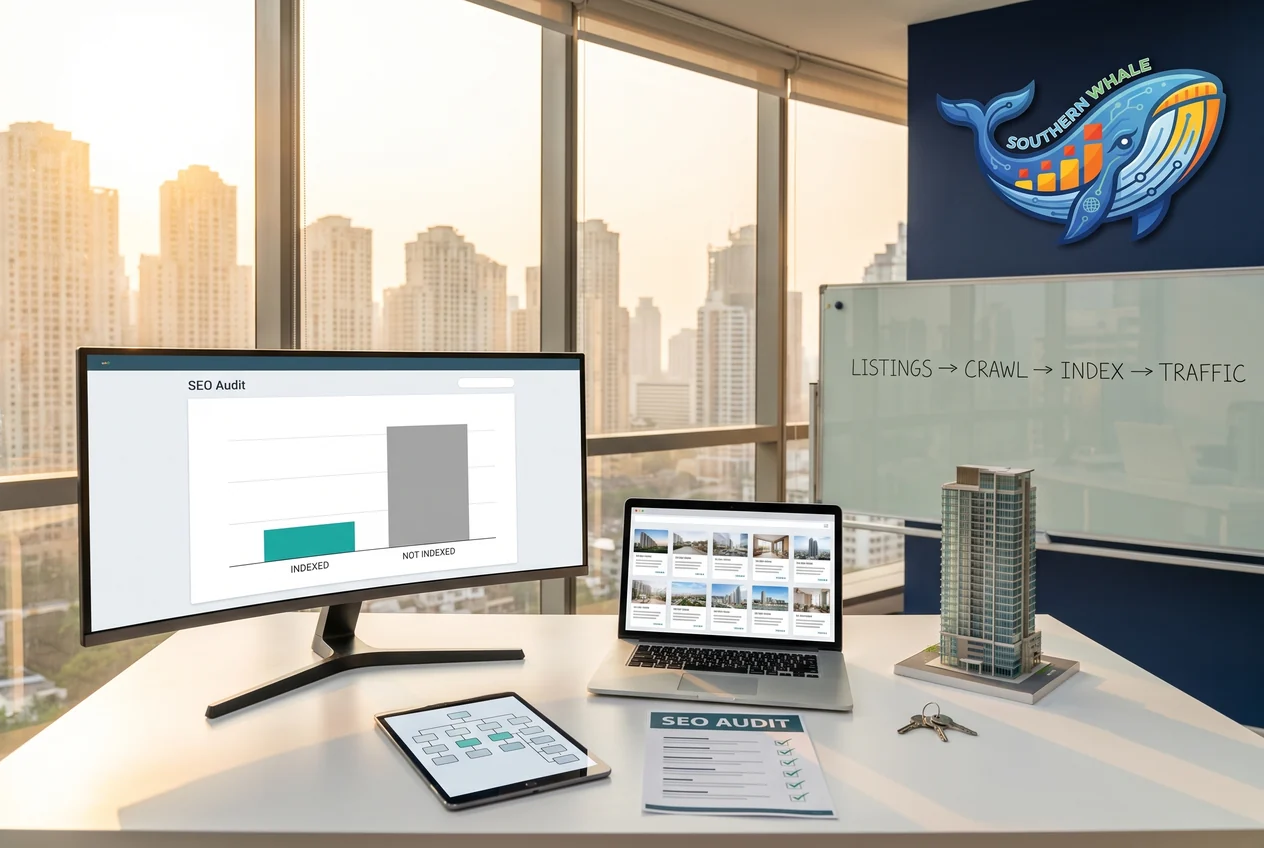
Real Estate Agency / Property Listings
2,240 → < 600Crawled – currently not indexed (plan target)
A Bangkok Property Agency With 2,300 Listings, Yet Google Indexed Less Than Half. The Audit Traced It to the URL Structure
Read the case
Automotive Parts / Genuine Parts Importer
1,576/1,576Products migrated, checked against the official export